

An honest EF Tour review of Germany, Switzerland & Austria. Discover what to expect on hotels, food, pacing, Mount Rigi, and how to get $100 off your trip.
I’ve shared in past articles about my Irish heritage, growing up Irish Catholic with a mother whose maiden name is Sweeney (you can read all about that adventure in my EF Tour review of Ireland. But on my father’s side, I am German. He was a Seidel, which loosely translated means a “mug of beer,” and was raised Methodist.
For this trip, I felt drawn to explore Bavaria, the region where the Seidel roots run deep. I wanted to see the historic Protestant churches that trace back to the legacy of Martin Luther, gaze at the dramatic peaks of the Alps, and, of course, sample authentic German beer. I was ready to cruise down the Autobahn and raise a glass inside the historic Hofbräuhaus.
When I saw that EF Go Ahead combined Germany and Switzerland with an optional day excursion into Austria, I didn’t hesitate to book. What follows is my completely honest review of our 9-day journey through Germany, Switzerland, and Austria: what was breathtaking, what surprised me, and the moments where things didn’t go quite as planned.
A note: EF Go Ahead has been my absolute go-to for stress-free international travel. If you’re wondering how they handle other destinations, read my comprehensive Ultimate Guide to EF Go Ahead Tours: My Real Experience Across 12 Countries to see how the logistics, hotels, and groups compare.
Booking an EF Go Ahead Tour?
Use my verified referral link to get $100 OFF your first booking.
Trip Snapshot: Germany, Switzerland & Austria at a Glance
| Tour Feature | Rating & Breakdown |
|---|---|
| Tour Operator | EF College Tours |
| Duration & Countries | 9 Days: Germany, Switzerland, Liechtenstein, and Austria |
| Pace of Travel | Fast-Paced: Multiple one- and two-night hotel stays with significant coach transit |
| Physical Activity | High: Expect 12,000–18,000 steps daily across cobblestones, castle hills, and towers |
| Standout Highlights | Rothenburg wall walk, Dachau Memorial, Mount Rigi alpine ascent, Neuschwanstein Castle |
| Included Meals | Daily hotel breakfast buffet + select multi-course group dinners |
| Best Suited For | Travelers eager to see major European bucket-list sights in a single organized sweep |
Meet Our Tour Director: Stephan
Every guided group tour lives or dies by its Tour Director, and we lucked out with Stephan. Born and raised in Berlin, Stephan was helpful, energetic, organized, and genuinely funny.
He operated with that distinct blend of German efficiency and lighthearted warmth. He ensured we were punctual at every coach pickup, kept us thoroughly briefed on the day ahead, and checked repeatedly that everyone had their passports and luggage in tow before our bus rolled out of a hotel parking lot.
As friendly as he was with every single guest, Stephan was remarkably camera-shy, meaning I walked away from the entire week without a single photo of him. Regardless, his storytelling and regional knowledge made the trip seamless.
Stop 1: Rothenburg ob der Tauber & The Romantic Road
As is standard with transatlantic EF Tours, after a full night of overnight flying you hit the ground running. We touched down in Frankfurt, cleared customs, and boarded our private motorcoach.
Our first destination was the preserved medieval walled town of Rothenburg ob der Tauber, nestled in the heart of Bavaria along Germany’s famous Romantic Road.
Going back to at least 950 AD, Rothenburg has endured a turbulent history. During the 1930s and 1940s, the town held deep significance for Nazi party ideology as an idealized medieval German community. Because of this connection, Allied forces bombed parts of the town near the end of World War II, damaging historic structures. Fortunately, a local military commander surrendered rather than seeing the city razed, sparing the ancient core. In the decades since, generous donations from international visitors and locals have restored the timbered houses and ramparts to their storybook charm.
My son Johnathan and I spent our free afternoon walking the perimeter of the ancient defensive walls. We climbed to the very top of the town hall clock tower, the highest lookout point in Rothenburg, though not before leaving our signatures on the wall inside the narrow stairwell!
Walking the Rothenburg Wall
The fortified stone wall wraps around Rothenburg for roughly two miles. If you plan to walk the full circuit, budget at least 1.5 to 2 hours, especially if you stop to read the donor plaques embedded in the masonry or pause for scenic valley photos along the way.


Rothenburg Tour & Stay Review
Accommodations (Good): Our hotel in Rothenburg was a charming, family-owned property tucked right inside the historic village. The dining room occupied an adjoining historic structure where the hosts prepared our dinner by hand in the kitchen next door.
The Food (Satisfying but Hearty): We were served a traditional Bavarian dinner of crispy pork Schnitzel paired with egg noodles (spätzle). It was filling comfort food, which was exactly what we needed before falling asleep after nearly 24 hours of non-stop travel. Traditional German cuisine focuses heavily on pork, potatoes, and bread, which can feel repetitive over several days, but this first home-cooked meal hit the spot.
Breakfasts & Coffee: The breakfast spread offered fresh rolls, cheeses, and cold meats. My favorite morning feature on European tours is the push-button cappuccino and espresso machines in the hotel breakfast rooms, which I relied on heavily to shake off the jet lag!
Pace & Excursions: Excellent. We had a guided walking orientation followed by plenty of independent free time. We never felt rushed through Rothenburg’s cobblestone alleys.
Stop 2: Nuremberg & Munich, Germany
Leaving Rothenburg, our coach routed southeast toward Munich. Along the route, Stephan surprised us by adding a stop in Nuremberg for several hours.
Nuremberg is a vibrant medieval city layered with modern history. It was the site of massive Nazi rallies in the 1930s and later hosted the historic Nuremberg Trials following WWII. Near the entrance to the city stands a preserved slab of the Berlin Wall, a striking reminder of Germany’s twentieth-century partition. We hiked up to the Imperial Castle, enjoyed lunch at an outdoor café, and then continued our journey to Munich.


Visiting the Dachau Concentration Camp Memorial Site
Our first stop the next morning, after checking into our hotel, was the Dachau Concentration Camp Memorial Site. Dachau was the first camp of its kind, and a model for those, like Auschwitz, that came after, serving as a “school of violence” for the SS troops. 41,500 innocent people were murdered here. On April 29, 1945, American troops liberated the survivors. A photo of that liberation is displayed in the visitor center.
It is difficult to walk these grounds, and I did so in complete silence, thankful that Stephan had brought us there early in the morning before the throngs of middle school students arrived, which they did as we were leaving.


BMW Showroom, The Hofbräuhaus & City Exploring
After the heaviness of Dachau, our afternoon shifted to quintessential modern and historic Munich:
The BMW Welt & Showroom: We toured the futuristic architectural complex, admiring the newest performance cars on display.
The Original Hofbräuhaus: We gathered as a group for lunch beneath the painted vaulted ceilings of Munich’s most famous beer hall. Between the brass band, oversized soft pretzels, and cold Bavarian beer, the energy inside was infectious.
Shopping Tradition: Johnathan and I spent the rest of the afternoon wandering the pedestrian shopping avenues around Marienplatz, continuing our long-standing travel tradition of stopping at H&M to pick out an outfit to remember the trip by.


Munich Lodging & Dining Review: Our Hotel Bar Misadventure
Our Munich hotel was modern, clean, and well-located for our touring days. However, one evening brought an unexpected twist: when several of us stopped by the hotel’s on-site bar for a nightcap, the staff refused us service and asked us to leave the lounge area.
It turned out the hotel was also hosting a large high school tour group that night, and the front-desk staff had confused our adult travelers with the teenagers! Stephan stepped in immediately to explain the situation, but when the staff remained stubborn, we simply walked down the street to an authentic Bavarian neighborhood pub. We ended up having a great evening drinking local wine and laughing about the misunderstanding.
By the next morning, hotel management realized their mistake and treated us warmly throughout breakfast.
Optional Excursion: A Day Trip to Salzburg, Austria
While based in Munich, our tour offered an optional full-day excursion across the border into Salzburg, Austria. A smaller contingent of our group signed up, and it proved to be one of the top days of the itinerary.
We started the morning with a guided tour through historic subterranean salt mines, suiting up in miner overalls and sliding down wooden chutes into the caverns.
From the mines, we drove into the heart of Salzburg, the birthplace of Wolfgang Amadeus Mozart and the cinematic setting for The Sound of Music. We wandered through the Mirabell Gardens reenacting the famous Do-Re-Mi steps around the Pegasus fountain before exploring the fortress viewpoints and baroque plazas on our own.
To top off the afternoon, Stephan played The Sound of Music on the overhead motorcoach screens during our scenic ride back across the German border.


Is the Salzburg Excursion Worth It? Yes. If you appreciate alpine landscapes, classical music history, or film nostalgia, the day trip delivers great scenery and smooth logistics without the stress of navigating international train transfers.
Stop 3: Neuschwanstein Castle & Liechtenstein
Leaving Munich behind, our coach set off toward the Swiss border, stopping first at the world-famous Neuschwanstein Castle.
Commissioned by King Ludwig II of Bavaria in 1869 as an idealized medieval retreat, the castle sits perched dramatically against the jagged peaks of the Bavarian Alps. Ludwig was a passionate patron of composer Richard Wagner and designed the castle as a private theatrical world. Interestingly, the king slept only 11 nights in Neuschwanstein before his mysterious death in 1886.
How to Reach the Castle Gates
To get from the village ticket center up the steep hillside to the castle courtyard, you have three options:
The Shuttle Bus: Quick, affordable, and drops you near the Marienbrücke (Mary’s Bridge) lookout.
Horse-Drawn Carriage: Traditional and scenic, though carriages stop short of the entrance, leaving a 5- to 10-minute uphill walk.
Walking Uphill: The direct mountain trail is steep and takes 30 to 40 minutes. If you want to conserve your energy for the castle staircases, take the shuttle up and walk down afterward.


Crossing Liechtenstein
After touring Neuschwanstein, we crossed through the Principality of Liechtenstein, the fourth-smallest nation in Europe, spanning just 62 square miles. Tucked snugly between Austria and Switzerland along the Rhine, it made for a lovely border crossing with soaring alpine ridges rising up on either side of the highway.

Stop 4: Lucerne, Switzerland & Mount Rigi
We pulled into Lucerne late in the evening. Although darkness hid the surrounding mountains, the rhythmic sound of water lapping against the lake shore was right outside.
A few of us dropped our bags and walked to a lakeside tavern patio. Even with a crisp March chill in the air, the staff had a wood-burning fire roaring and draped thick sheepskins over each outdoor chair so we could sip Swiss wine in comfort under the stars.
Our Lucerne hotel was definitely dated as it hadn’t seen a significant renovation since the 1970s, but my room was spotless. When I fell asleep that night, the window above my bed looked out into pitch black.

The next morning, I pulled back the curtains to this view:

The Mount Rigi & Lake Lucerne Excursion
EF gave travelers two options for this day:
Option A: Ride the coach directly into downtown Lucerne for self-guided sightseeing and shopping.
Option B: Embark on the mountain excursion featuring an aerial cable car ascent up Mount Rigi, an antique cogwheel train descent, and a scenic ferry cruise across Lake Lucerne.
We chose the mountain adventure, and it was the undisputed scenic highlight of the entire 9 days. Stepping out onto the observation deck above the sea of clouds at Mount Rigi felt like standing on top of the world. Gliding across the glass-still water of Lake Lucerne on the ferry completed a day of views you normally only see on postcards.


The Honest Food Review: Our “Spaghetti & Ketchup” Evening
While the landscapes were a 10 out of 10, dinner that evening provided our group’s funniest memory.
At our included group dinner, the hotel kitchen served plates of pasta tossed in warm tomato ketchup. Stephan immediately caught the confusion, approached the waitstaff, and politely explained that while Americans certainly enjoy ketchup, we don’t put it on spaghetti! The kitchen apologized and promised something exceptional for the next night, which humorously turned out to be an assortment of leftover cocktail appetizers from an on-site wedding reception held the previous evening.
Again, this was a college tour and not a Go Ahead adult tour, so these misadventures are part of the, well, adventure!
Stop 5: The Black Forest & Heidelberg, Germany
Leaving Switzerland, our coach headed back northward into Germany, winding through the dense evergreen ridges of the Black Forest.
We stopped at an authentic cuckoo clock workshop to watch woodcarvers demonstrate their craft, followed by an indulgent lunch featuring generous slices of traditional Black Forest cherry cake (Schwarzwälder Kirschtorte).


Ready to Plan Your European Tour?
Booking a guided tour takes the friction out of rail transfers, hotel rotations, and international border logistics. If you’re eyeing this itinerary or another EF Go Ahead adventure, don’t pay full price.
Save $100 On Your EF Go Ahead Tour Booking →Our final overnight stop was the university town of Heidelberg. We took a funicular up to the sandstone ruins of Heidelberg Castle, walked through the gardens, and stood beside the Heidelberg Tun, the world’s largest wine vat, capable of holding over 58,000 gallons of wine. Afterward, Johnathan and I spent our remaining Euros along Heidelberg’s Hauptstraße, the longest continuous pedestrian shopping street in Europe, stopping again at H&M where I picked up some very stylish slacks.


That evening, our tour group gathered for a farewell dinner, raising our glasses to Stephan and celebrating 9 packed days of shared memories across four countries.
Go or No? 4 Practical Tips Before You Book This Itinerary
If you are getting ready to book this trip with EF Go Ahead Tours, keep these practical tips in mind:
1. Be Ready for a Brisk, Fast-Moving Pace
This 9-day itinerary covers significant mileage across Germany, Austria, and Switzerland. You will change hotels every one to two nights and board the motorcoach early on travel mornings. If you prefer slow travel where you unpack once for a week, this style will feel rushed; if you want to sample multiple regions in one vacation, it delivers outstanding value.
2. Pack Two Pairs of Supportive Footwear
Between cobblestone alleys in Rothenburg, the steep climb to Neuschwanstein Castle, and steps around the Dachau Memorial, you will log 6 to 9 miles on foot most days. Do not rely on a single pair of sneakers. Bring one pair of supportive walking boots and a comfortable lifestyle sneaker to swap between days.
My packing list for Italy is very similar to what I packed for this trip. Check out my blog on what to wear in Europe in the Spring for exact details on everything you need to look great and be comfortable.
3. Take Every Alpine Excursion Offered
The included city walking tours give a solid orientation, but the optional excursions, particularly Salzburg, Austria and Mount Rigi / Lake Lucerne provide the most memorable scenery of the entire vacation. Budget for these add-ons when calculating your trip costs.
4. Keep Cash (Euros & Swiss Francs) on Hand
While major stores and restaurants accept credit cards, public restrooms in Germany (like Sanifair stops along the Autobahn) typically require €0.50 to €1.00 in coins. Switzerland also uses the Swiss Franc (CHF), though most shops in tourist centers accept Euros and credit cards without issue.
Frequently Asked Questions About EF Tours Germany & Switzerland
Is this tour suitable for first-time visitors to Europe?
Yes. It provides an ideal introductory route because Germany and Switzerland have excellent infrastructure, clean facilities, and widespread English proficiency. Having a dedicated Tour Director and motorcoach removes the stress of navigating train schedules and language barriers.
How much luggage can I bring on the coach?
EF Go Ahead allows one standard checked suitcase (up to 50 lbs / 62 linear inches) and one carry-on bag or daypack per passenger for the motorcoach. Because you will change hotels frequently, traveling with a lighter 24- to 26-inch rolling bag makes hotel mornings significantly easier.
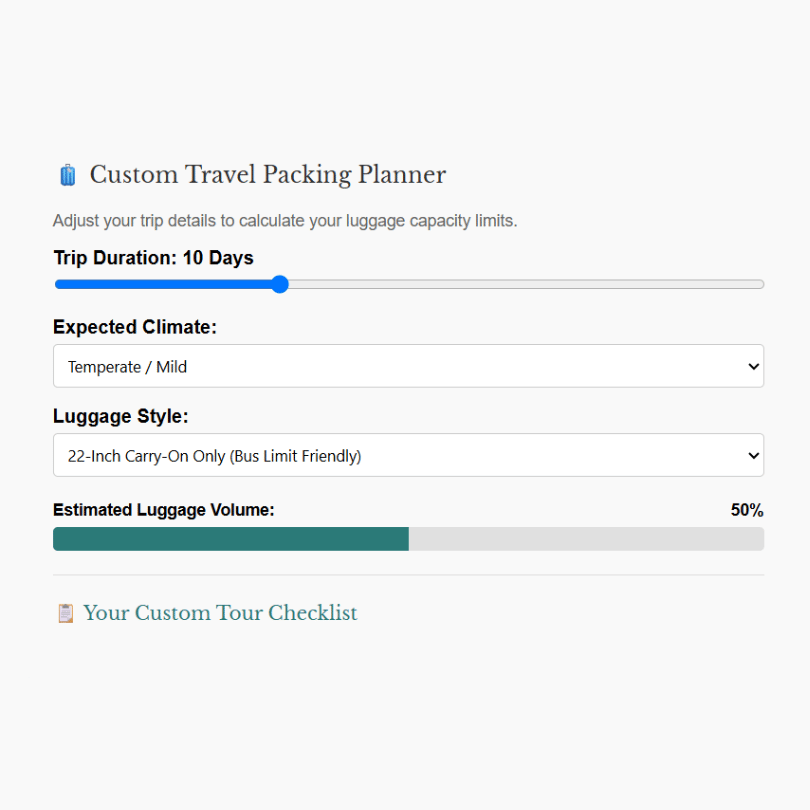
Pro tip: Use my luggage packing calculator to take the guesswork out of packing your suitcase.
Are EF Go Ahead Tours good for solo travelers?
Absolutely. A large percentage of travelers on EF Go Ahead departures travel solo. You can either pay a single room supplement to guarantee your own private hotel room or opt to be paired with a traveler of the same gender to waive the single room fee. Check out my review of my solo trip to Scotland and London with EF Go Ahead Tours.
To view additional photos from our journey through Bavaria and the Swiss Alps, visit my photo gallery and connect with me over on Instagram at @offdutytraveler!
Auf Wiedersehen and see you on the next trip!
Thanks for sharing this with us – the photo’s look amazing! Keep up the great content.